
1. Lac Bay
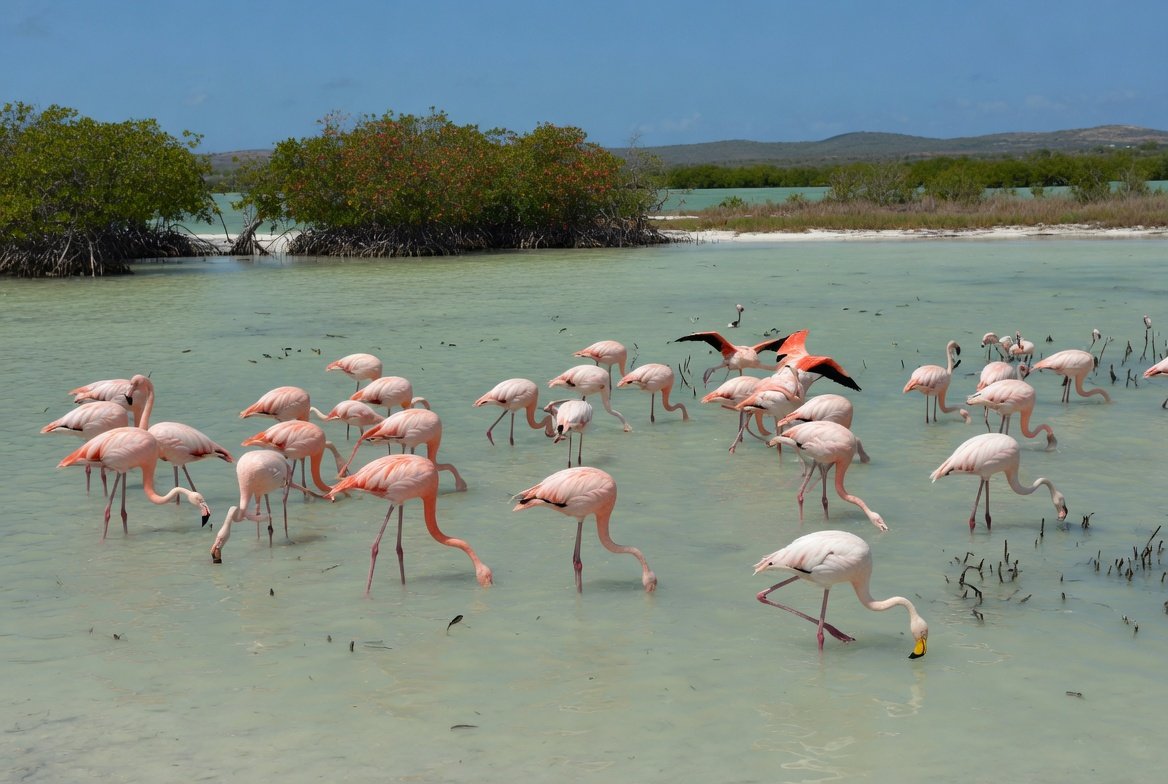
Bonaire’s largest bay is a protected UNESCO World Heritage lagoon on the southeastern coast. The shallow turquoise waters, framed by dense mangrove forests, attract kitesurfers whose colorful kites arc overhead against a brilliant blue sky. Golden-hour light turns the bay into a mirror of pinks and oranges, while flamingos wade along the shoreline and herons patrol the mangrove edges. Wide-angle shots here reward patience — arrive just before sunrise for the best reflections and the calmest conditions.
2. Gotomeer (Goto Lake)
This inland saltwater lake on the western side of the island is one of the finest flamingo photography locations in the entire Caribbean. Hundreds of Caribbean flamingos congregate in the shallow, mineral-rich water to feed, and early-morning visitors are treated to synchronized lift-offs as the birds take to the air in a blaze of pink and crimson. Soft pre-dawn light eliminates harsh shadows and gives feathers a luminous glow — bring a 400 mm or longer lens and approach slowly along the roadside.
3. Pekelmeer Salt Flats
The southern salt pans are one of Bonaire’s most surreal landscapes. Towering white salt pyramids rise against a vivid blue sky, while the surrounding brine pools cycle through shades of rose, lavender, and deep crimson as algae and salt-loving bacteria respond to changing light and seasons. Historic painted slave huts dot the shoreline and add human scale to wide compositions. A flamingo sanctuary at the water’s edge means wildlife photography opportunities are never far away.
4. Washington Slagbaai National Park
Covering the entire northwestern third of the island, this vast wilderness park delivers the widest variety of subjects on Bonaire. Volcanic coastlines, hidden coves, cactus-studded desert, freshwater ponds loud with parakeets and hummingbirds, and open-sea panoramas from hilltop tracks all compete for the lens. Within the park, Boka Slagbaai — a sheltered bay with crumbling colonial-era salt works — combines dramatic seascape with historical atmosphere. Allow a full day and go early before the heat peaks.
5. Klein Bonaire
The small, flat, uninhabited island lying just a short water-taxi ride from Kralendijk harbour is ringed by some of the clearest water in the Atlantic basin. Above the surface the untouched beach and translucent shallows produce classic Caribbean compositions. Below the surface the reef is a living art gallery: hawksbill sea turtles cruise past barrel sponges, spotted eagle rays sweep across the sandy bottom, and schools of blue tang part around snorkelers. A housing for your camera or a GoPro unlocks the best of this site.
6. Thousand Steps
Despite the name there are only 67 concrete steps, but they cut dramatically down a rocky limestone cliff to the Caribbean Sea and make a compelling photographic subject in their own right. The staircase frames the turquoise water at the base and the cactus-dotted cliff face on either side. At the waterline a pristine coral garden extends along the wall — one of Bonaire’s most accessible shore-dive sites. Shoot the steps themselves in the early-morning window before the light turns harsh and the divers arrive.
7. Sorobon Beach
Tucked inside the sheltered tip of Lac Bay, Sorobon is a calm, shallow beach that turns extraordinary shades of turquoise and jade under the midday sun. Kitesurfers glide silently across the water in the background while the beach itself stays uncrowded. Late afternoon is the magic hour: the trade winds pick up, the kitesurfers multiply, and the warm sidelight sculpts every ripple in the sand. Polarizing filters are essential here to cut through surface reflection and reveal the full depth of the colour.
8. Rincon
Founded in 1527, Rincon is the oldest settlement in the Kingdom of the Netherlands and the most characterful village on the island. Pastel-painted colonial houses, a whitewashed church, and a shaded village square give street and architectural photographers rich material. Colourful details are everywhere: flowering bougainvillea climbing old stone walls, ornate wooden shutters faded to chalky perfection, and doorways framing glimpses of private courtyards. Visit on a weekday morning for the quietest light and the fewest distractions.
9. Seru Largu
This prominent hilltop rises to about 130 metres and offers the best panoramic viewpoint on Bonaire. From the summit you can photograph the southern salt pans, the turquoise outline of Klein Bonaire, the terracotta rooftops of Kralendijk, and the open Caribbean all in a single sweep. Sunrise visits are especially rewarding: the sky ignites above the island while the sea below is still dark and smooth. At sunset the salt pans glow amber and the shadows of the salt pyramids stretch toward the horizon.
10. Spelonk Lighthouse
Perched on the rugged northeastern tip of the island, the Spelonk Lighthouse has guided ships since 1868 and presides over one of Bonaire’s most dramatic and windswept coastlines. Atlantic swells crash against jagged volcanic rock and send spray fountaining into the air — ideal for long-exposure work that blurs the foam while keeping the lighthouse sharp against a brooding sky. Divi-divi trees bent permanently westward by the trade winds add texture and narrative to compositions. This is the wild, raw side of Bonaire that most tourists never reach.